


Foundation for Black skin: how to choose the right one (shade, undertone, finish)
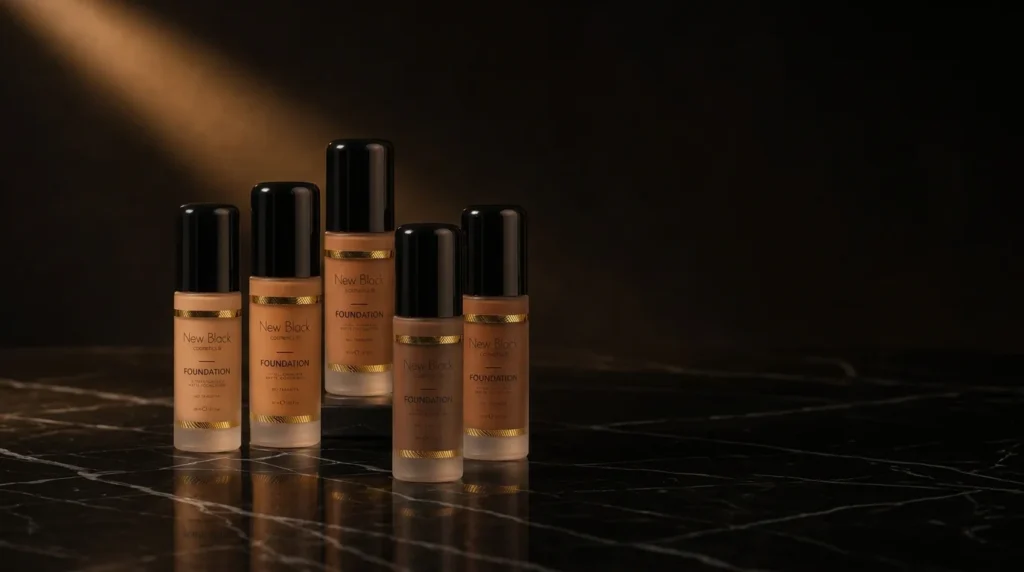
A NEW BLACK guide, the Paris makeup brand made for Black and Brown skin tones, reviewed by Charlotte Mambo, the brand's makeup artist.
A good foundation for Black skin is recognised by three things: it's built on brown, red or golden pigments (not pink), it exists in your undertone and your depth, and it disappears on the jawline in daylight without turning grey after an hour. This guide teaches you to choose yours in four steps, to test it, to apply it without a line, and to avoid the mistakes that make a "mask" or a "dull complexion".
This is the "complexion" guide of our complete guide to makeup for Black and Brown skin. NEW BLACK is a French house designed in Paris with one trade only: the complexion of Black and Brown skin tones. What we explain here is what our makeup artist applies every day.
Why do so many foundations "not work" on Black skin?
Because they were formulated for light skin and then darkened, their ranges stop too early, and they ignore the undertone. The result: a shade that looks right in the bottle and grey, orange or dull on the face.
- Pigments. Black and Brown skin leans golden, red-brown, olive or copper. A "dark" foundation built on a pink base gives a grey veil. You need brown, red and orange pigments, and a range of undertones.
- The number and distribution of shades. Many ranges offer twenty light shades and three deep ones, separated by big gaps. You end up "between two". What matters isn't the total number of shades but their distribution from light to deep and the presence of undertones.
- Oxidation. Some formulas darken or change undertone on contact with oil and air. On Black skin, the difference shows immediately.
- Texture. A thick texture applied to "cover" darker areas becomes a mask; a texture that's too hydrating shines within an hour on an oily T-zone.
Our stance: six shades done properly, from light to deep, built on the right pigments, rather than forty approximations. And a tinted powder in the same shades to adjust.
Step 1: know your undertone
The undertone is the hue beneath the surface of the skin: warm (golden, red-brown), cool (pink, bluish), neutral or olive. It doesn't depend on the depth of your complexion. Very dark skin can be cool; light mixed-heritage skin can be very warm.
Three tests, without makeup, by a window:
- The veins on your wrist. Greenish: warm. Blue or purple: cool. Both: neutral.
- Jewellery. Gold lights you up: warm. Silver suits you better: cool. Both: neutral.
- White fabric. Against a white sheet, your skin looks golden or peachy: warm; pink or bluish: cool; greenish: olive.
The classic trap: thinking "Black skin = warm undertone". It's wrong in a good share of cases, and it's the first cause of a foundation turning orange or grey. Test details and special cases in our Shade guide and in Know your undertone.
Step 2: choose the depth (from light to deep)
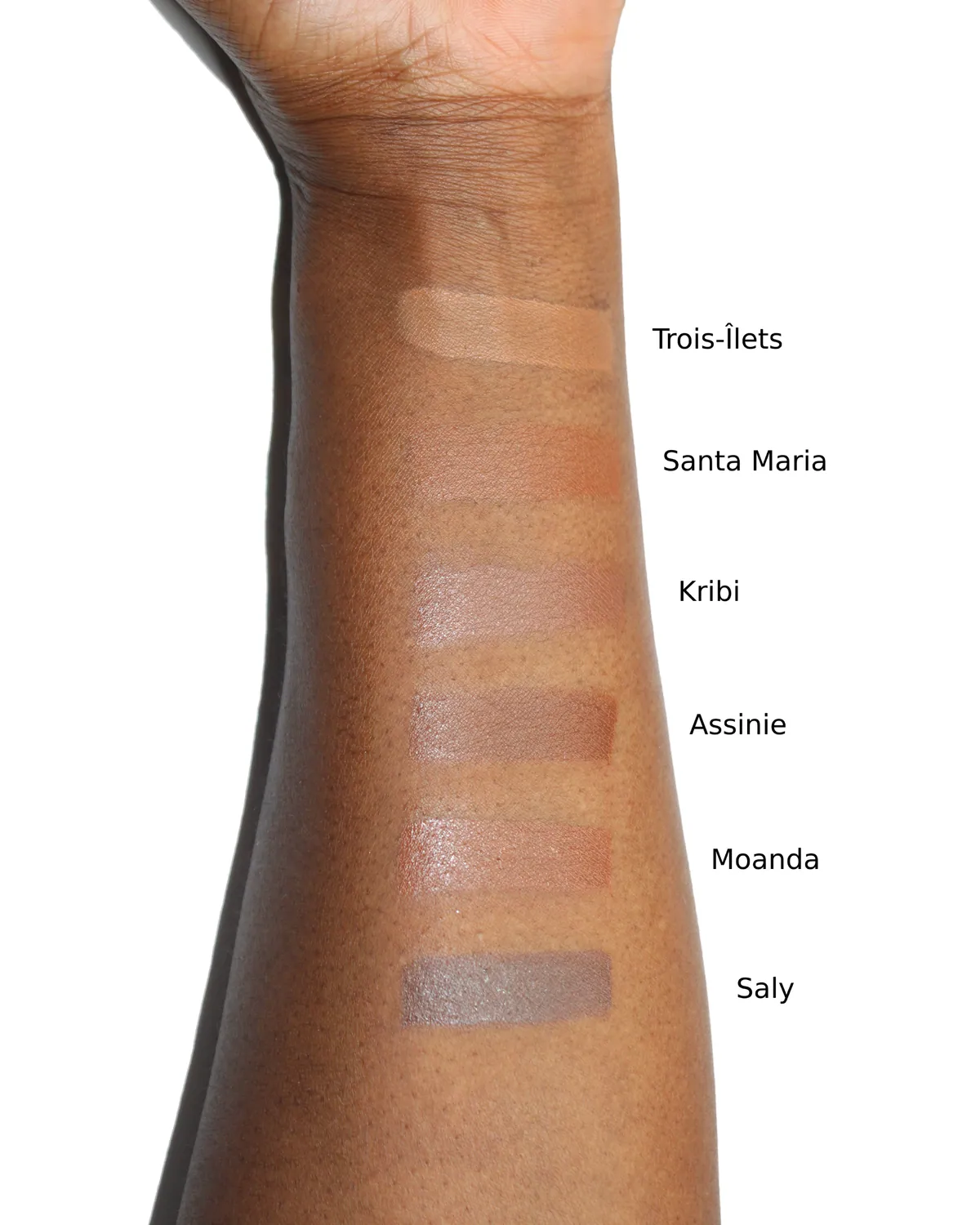
Test three neighbouring shades on the jawline, never on the hand, wait ten minutes, and keep the one that disappears. Between two, take the deeper one.
The hand and wrist are lighter than the face; the neck is often lighter than the cheeks. The right reference point is the jawline, which joins the face and the neck: the right shade blends in there without being seen. The ten-minute wait lets the formula oxidise if it's going to.
Our six shades, from light to deep: Trois-Îlets, Santa Maria, Kribi, Moanda, Assinie, Saly. Each is designed for a family of Black and Brown complexions, with a readable undertone: if you know your shade in another brand, the Shade guide gives the equivalents.
Step 3: choose the finish and coverage

Matte or velvet if your skin shines (the most common case) or for a long day; satin if your skin is dry or mature. Light to buildable coverage in all cases: you build in thin layers.
| Your skin | Recommended finish | Coverage | To avoid |
|---|---|---|---|
| Combination to oily, shiny T-zone | Matte or velvet, long-wear | Buildable | Very hydrating or luminous formulas everywhere |
| Dry, tight | Satin, fluid | Light | Powdery matte, powder on the cheeks |
| Mature (50 and over) | Satin, thin | Light | Thick coverage, full matte |
| Dark spots, hyperpigmentation | Velvet | Buildable, corrected in dabs | A thick layer everywhere "to cover" |
| Light mixed-heritage or olive skin | Velvet or satin | Light | Pink shades |
A matte finish doesn't mean "flat": the light then comes from the highlighter on the high points, never from a lighter shade.
Step 4: wear and transfer
A transfer-proof foundation lasts all day without staining collars, headwraps or hands. On Black skin, it's a real comfort: light clothes, ceremonies, heat.
"Transfer-proof" comes from the formula (a thin film that dries on the skin) and the application (thin layers, drying time). It doesn't dry out the skin if it was moisturised first. Our no-transfer fluid foundation is rated 4.9/5 by 24 customers; the comment that comes up most: "it doesn't stain my collar". Full explanation: Transfer-proof foundation: how it works.
How to test a shade without getting it wrong
By a window, without makeup, three stripes on the jawline, ten minutes, a phone photo without a filter. The right shade is the one you can't find on the photo.
- In store: step out into daylight before deciding; yellow or white neon lights distort everything.
- Online: use a shade guide with equivalents, send a photo taken by a window for advice (we do this), and start with the recommended shade rather than "the best seller".
- If you hesitate between two: the deeper one, adjusted with powder.
How to apply foundation on Black skin
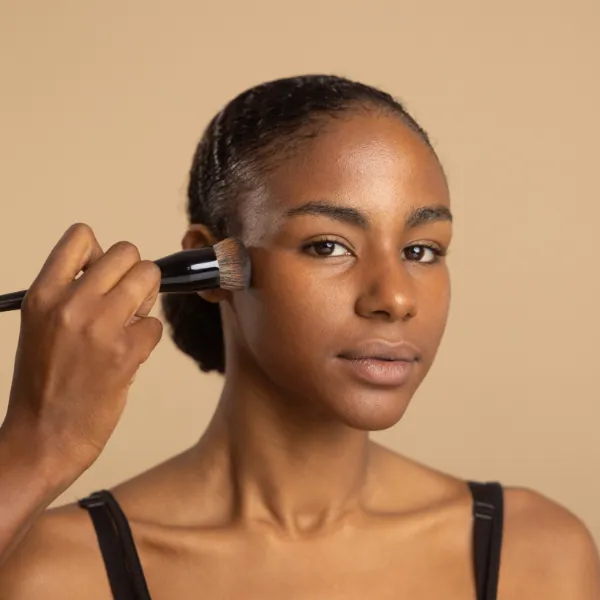
A hazelnut-sized amount for the whole face, with a damp sponge from the centre outwards, then a second touch only on the areas that need evening out: sides of the nose, around the mouth, chin. Blend down to the neck and out to the ears.
- The damp sponge gives the most natural and thinnest result.
- The dense brush covers more: useful on areas that need evening out.
- Fingers warm the product: perfect for light coverage.
- Never a thick layer everywhere to "cover": you correct in dabs, with a concealer in the exact shade or half a shade deeper on dark spots.
Why does my foundation turn grey?
Four causes in almost every case: a shade too light, a pink undertone on golden skin, white translucent powder, dehydrated skin. All four can be fixed: exact shade (never lighter), vein test, tinted powder, moisturising five minutes before. If the grey appears after an hour, it's oxidation: choose a stable formula and lightly powder the T-zone. All six causes are detailed in Foundation that turns grey or ashy.
According to your skin
- Mixed-heritage skin, "between two shades": undertone matters more than depth (often olive or golden). Choose the shade closest to your neck, adjust with powder; mixing two shades is also possible.
- Olive and tan skin: avoid pink foundations; look for "golden", "warm" or "olive".
- Very dark skin: the exact shade is vital; a lighter shade greys immediately. Deep powder, copper highlighter.
- Oily skin: mattifying primer on the T-zone, long-wear foundation, powder touch-ups. Our guide: Foundation for oily Black skin.
- Dry skin: moisturise, satin foundation, no powder except on the nose.
- Mature skin: thin satin foundation; we reveal, we don't cover.
- Dark spots: concealer in the exact shade or deeper, tapped on the spot, before foundation in a thin layer.
The 8 mistakes that ruin a foundation on Black skin
- A lighter shade "to brighten".
- Testing on the hand or wrist.
- A pink base on golden skin (or the reverse).
- A thick layer to cover, instead of correcting in dabs.
- White translucent powder.
- Forgetting the neck and ears: the line.
- Doing your makeup under yellow light.
- Not moisturising first, then compensating with more product.
The NEW BLACK no-transfer fluid foundation
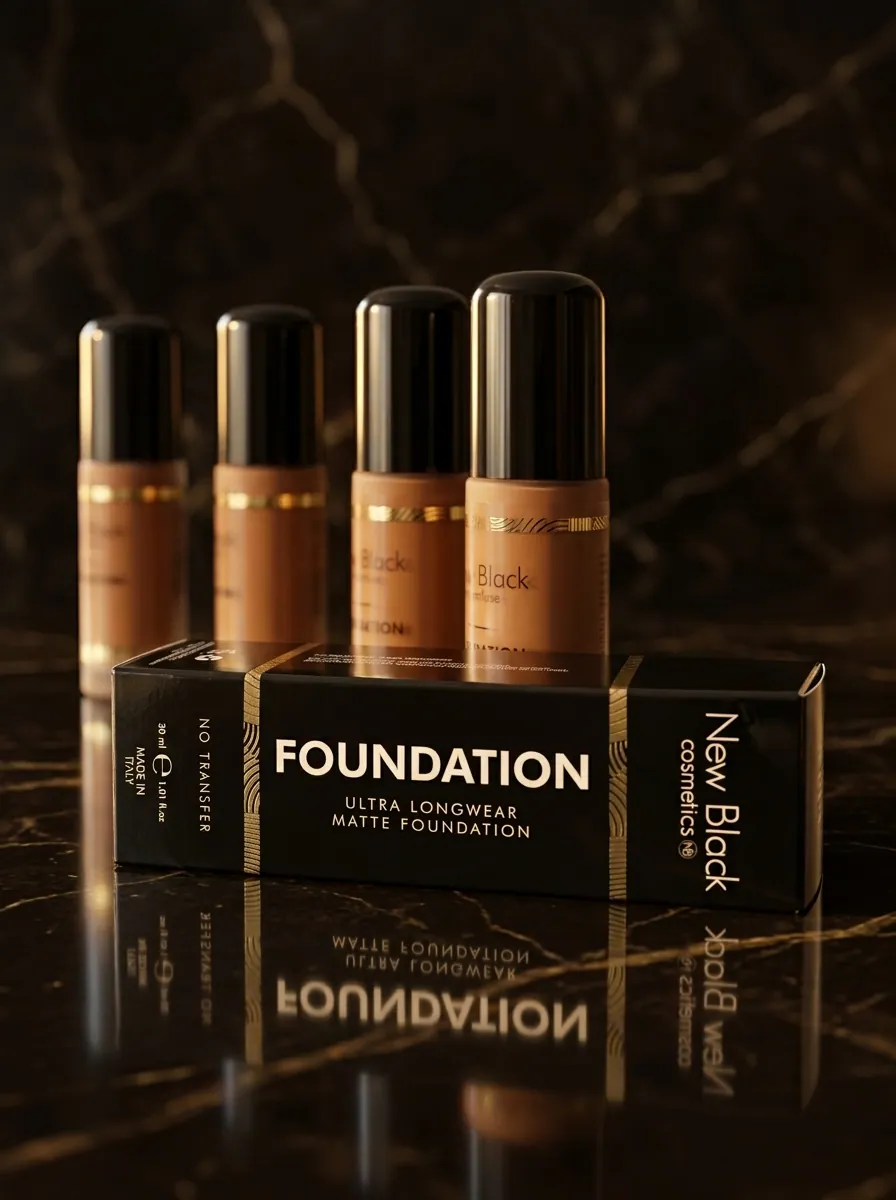
Six shades from light to deep, built on pigments designed for Black and Brown skin tones, a velvet finish, all-day wear without transfer.
- Shades: Trois-Îlets, Santa Maria, Kribi, Moanda, Assinie, Saly.
- Velvet finish, buildable coverage: a thin layer evens out, a second touch corrects.
- Transfer-proof: doesn't stain clothes or headwraps.
- Rated 4.9/5 by 24 customers.
- Its powder: the compact powder comes in the same shades to set and adjust.
- Unsure about the shade? Send us a photo taken by a window, without makeup: we reply with the recommended shade.
See the no-transfer fluid foundation · Find my shade
Our foundation guides
- Transfer-proof foundation: how it works, which one to choose
- Know your undertone when you have Black skin: the 3-minute test
- Foundation that turns grey or oxidises: why, and how to avoid it
- Foundation for oily Black skin: matte and long-wearing
- Powder for Black skin: compact, loose, mattifying
- NEW BLACK shade guide
- The beginner's makeup kit for Black skin
- Natural makeup on Black skin
Frequently asked questions
What foundation is best for Black skin?
A foundation built on brown, red or golden pigments (not pink), available in your undertone and your depth, with a finish suited to your skin (matte if it shines, satin if it's dry), and preferably transfer-proof. It should disappear on the jawline in daylight.
How do I find my foundation shade for dark skin?
First determine your undertone (veins, jewellery, white fabric), then test three neighbouring shades on the jawline by a window, wait ten minutes and keep the one you can no longer see. Between two, the deeper one.
Why does my foundation turn grey on my skin?
A shade too light, an undertone that doesn't match, white translucent powder or dehydrated skin. Fix these four points; if the grey comes after an hour, the formula oxidises: change formula and powder lightly.
Matte or luminous foundation for Black skin?
Matte or velvet if your skin shines or to last long; satin if it's dry or mature. The light then comes from the highlighter, not from a lighter shade.
Mixed-heritage skin: how do I choose between two shades?
Take the one closest to your neck, or the deeper of the two, then adjust with a tinted powder. Mixing two neighbouring shades is also a solution.
Does a transfer-proof foundation dry out the skin?
Not if the skin is moisturised five minutes before and if it's applied in thin layers. On very dry skin, choose a satin finish and powder only the nose.
How many shades should a range for Black skin have?
It's not the number that matters but the distribution from light to deep and the presence of undertones. Six well-built shades cover more complexions than twenty badly distributed ones.
What foundation for oily Black skin?
A long-wear matte or velvet finish, applied thin, with a mattifying primer on the T-zone and a tinted powder for touch-ups. Avoid very hydrating or luminous formulas.
Written by the NEW BLACK editorial team · Reviewed by Charlotte Mambo, NEW BLACK makeup artist · Updated 9 September 2026