


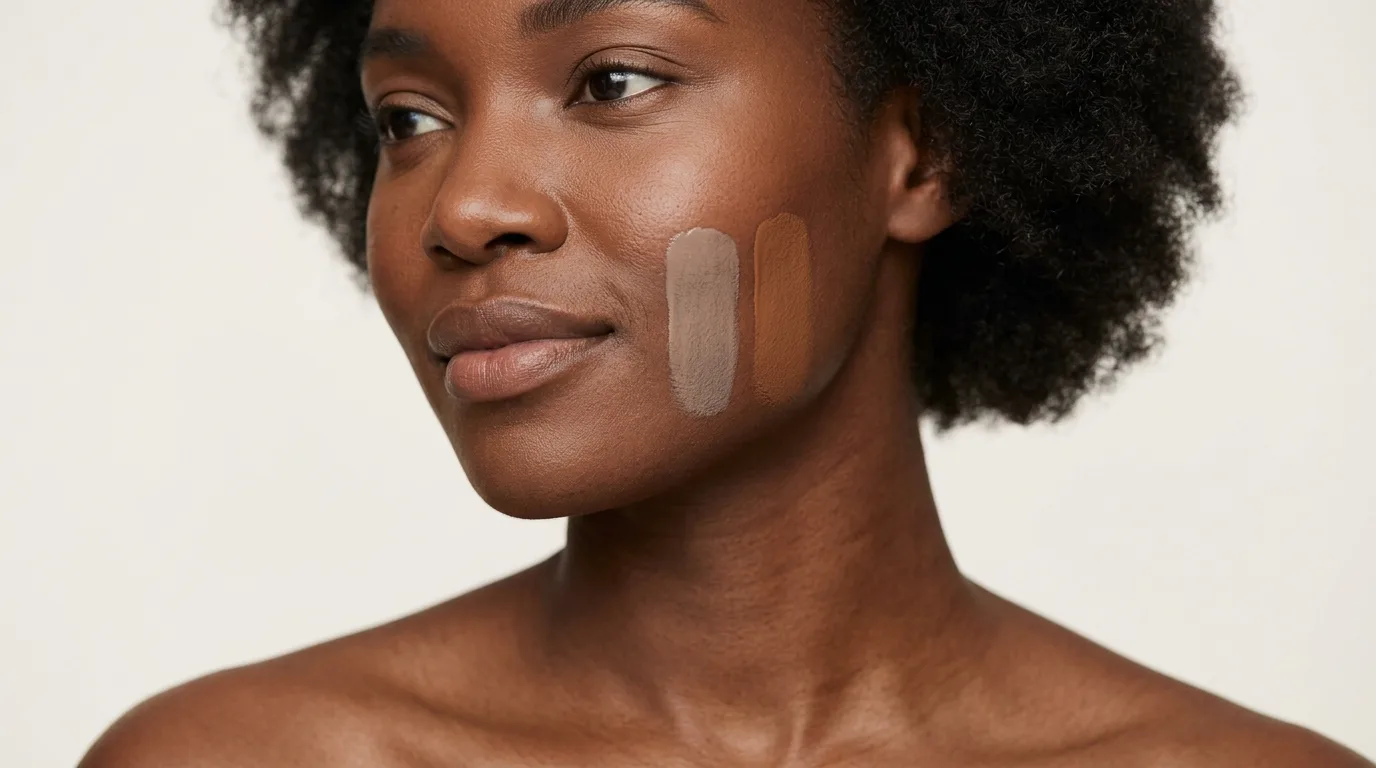
A NEW BLACK guide, the Paris makeup brand made for Black and Brown skin tones, reviewed by Charlotte Mambo, the brand's makeup artist.
A foundation that turns grey on Black or Brown skin almost always has one of these six causes: a shade too light, an undertone that doesn't match, white translucent powder, a formula that oxidises, flash or cold light, or dehydrated skin. All six can be spotted in a few minutes and fixed. Here's how to recognise yours and get back a complexion that keeps its warmth all day.
This article is part of our guide to foundation for Black skin.
What exactly is the ashy look?
It's a dull, ashen or whitish veil that appears on the face, immediately or after an hour, and gives the impression of tired or "powdered" skin. It comes from a mismatch between the product's pigments and your skin's, or from a white powder applied on top.
Black skin leans golden, red-brown, olive or copper. Anything that adds white, pink or grey on top breaks that warmth. The grey shows even more in photos, in flash and under cold light (neon, screens).
Cause 1: the shade is too light
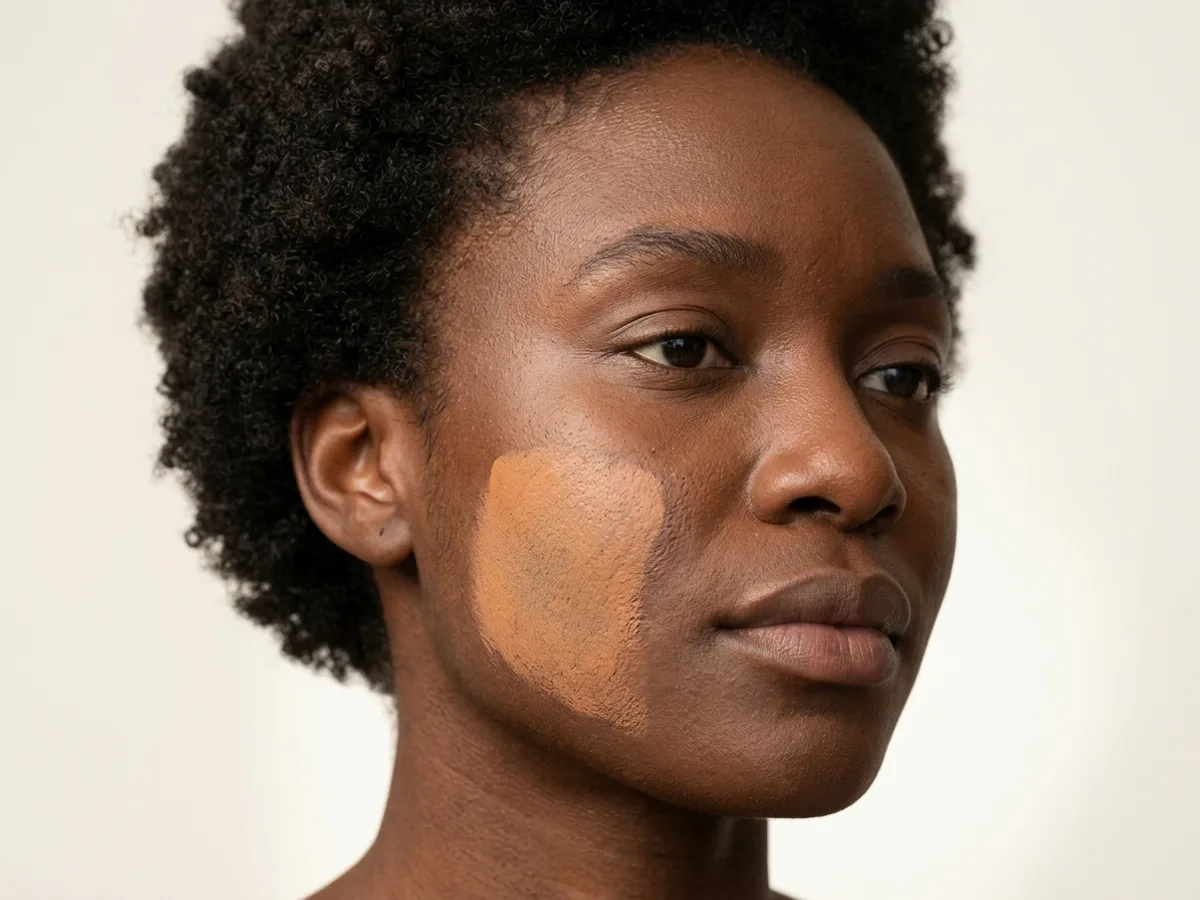
This is the first cause. A foundation lighter than the skin doesn't brighten it: it greys it, especially on the darkest areas (around the mouth, forehead).
How to tell: by a window, the foundation shows on the jawline as a lighter area; in photos, the face looks lighter than the neck.
The fix: your exact shade, never half a shade lighter. Between two, the deeper one. The light will come from the highlighter. Full method in the foundation guide.
Cause 2: the undertone doesn't match
A pink-based foundation on golden skin gives an ashen veil, even at the right depth. A very golden foundation on cool or olive skin gives an orange or yellowish veil.
How to tell: the shade seems "right" in depth but the complexion looks dull or orange everywhere, not just in one area.
The fix: the vein, jewellery and white fabric tests, explained in Know your undertone. Then a shade in your undertone.
Cause 3: translucent powder
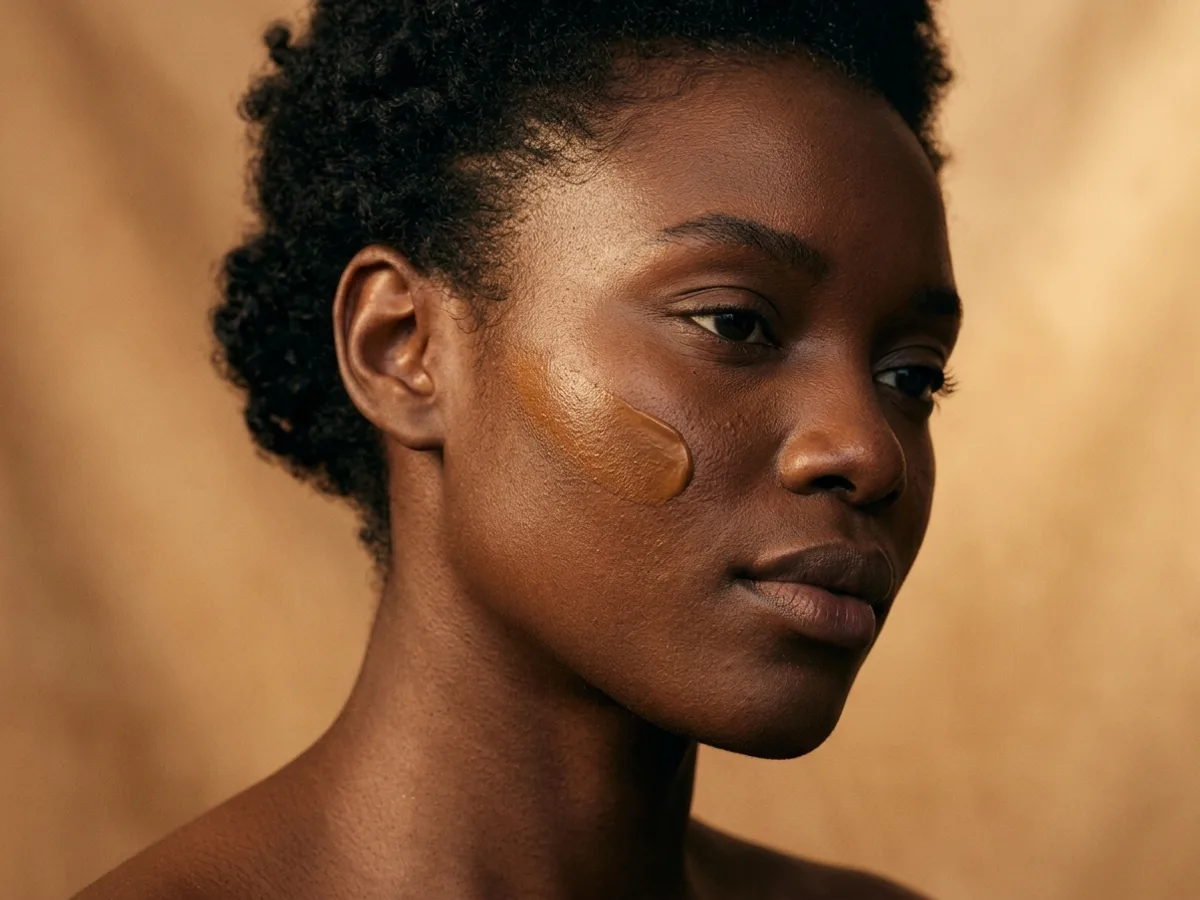
"Invisible" or "universal" powders contain white powders (talc, silica, starch). On light skin, they disappear; on Black skin, they leave a grey veil, very visible in flash.
How to tell: the foundation is perfect right after application, and the grey appears after powdering, or only in photos.
The fix: a tinted powder, in the shade of your foundation or half a shade deeper, applied only on the T-zone. Our compact powder comes in the six foundation shades for this reason.
Cause 4: the formula oxidises
Some foundations change colour on contact with oil, air and heat: they darken, pull orange, or go dull after an hour. That's oxidation. It mostly affects oily skin.
How to tell: the shade is right at application and "turns" after 30 to 60 minutes; on the T-zone first.
The fix: test a shade for ten minutes before deciding (oxidation already shows), choose a stable formula, apply a mattifying primer on the T-zone and a light tinted powder. If your foundation still oxidises, take half a shade lighter in the same undertone; it's the only situation where that's justified.
Cause 5: light and flash
Under cold light or flash, white powders, silver highlighters and pink foundations come out grey. In daylight, the same makeup looks normal.
How to tell: the complexion looks beautiful in the mirror and grey in evening photos.
The fix: tinted powder, golden or bronze highlighter (never white or silver), and a foundation shade checked by a window and with the phone's flash before a ceremony.
Cause 6: dehydrated skin
Skin that lacks water absorbs the foundation, makes it cling and turns it dull. Many Black skins shine on the T-zone while being dehydrated on the cheeks: they combine grey cheeks and an oxidising forehead.
How to tell: the complexion feels tight, settles into fine lines and looks flat-dull from application; the foundation "catches" on the cheeks.
The fix: moisturise, wait five minutes, then apply. A hydrating primer on the cheeks, mattifying on the T-zone.
The 7-point anti-grey checklist
- Exact shade, never lighter.
- Undertone checked (veins, jewellery, white fabric).
- Tinted powder, T-zone only.
- Ten-minute wait when testing to see oxidation.
- Moisturise five minutes before.
- Golden or bronze highlighter, never silver.
- Check by a window and with flash before an occasion.
What NEW BLACK does
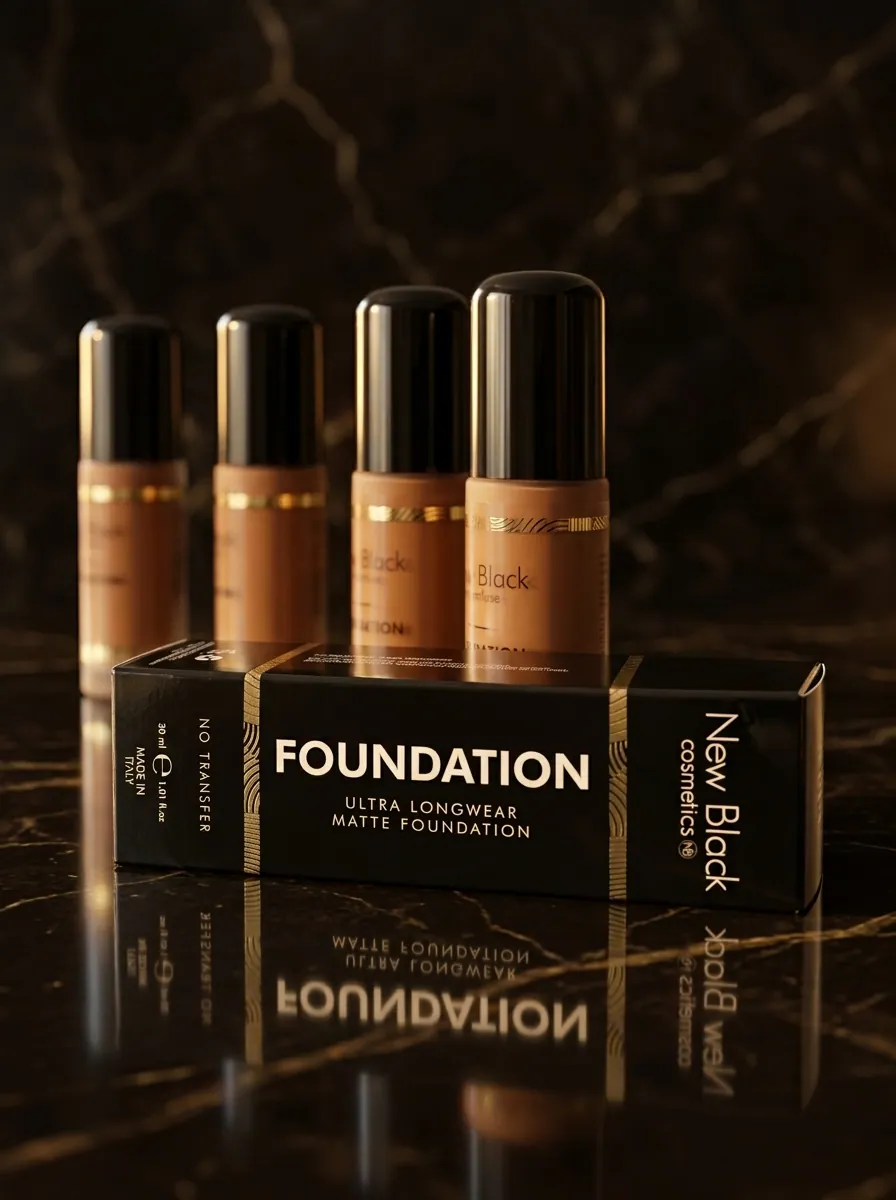
Our no-transfer fluid foundation is built on brown, red and golden pigments, not on a darkened pink base, in six shades from light to deep with readable undertones. Its compact powder is tinted in the same shades: it sets without a white cast. That's the meaning of our message "no more grey cast": the right pigment, the right shade, the right powder. Designed in Paris, made in Italy.
Frequently asked questions
Why does my foundation look ashy on dark skin?
Most often: a shade too light, a pink undertone on golden skin, or white translucent powder. More rarely: a formula that oxidises, flash, or dehydrated skin.
How do I stop my foundation oxidising?
Test the shade for ten minutes before choosing, moisturise the skin, apply a mattifying primer on the T-zone and a light tinted powder. If oxidation persists, change formula.
Which powder avoids the grey cast?
A tinted powder in the shade of your foundation or half a shade deeper, never a white translucent powder. On the T-zone only.
My foundation is grey only in photos: why?
Flash reveals white powders and silver reflections. Switch to a tinted powder and a golden highlighter, and test with your phone's flash before an evening out.
Can a lighter foundation brighten Black skin?
No: it greys it. The light comes from golden highlighter on the high points, with a foundation in the exact shade.
Written by the NEW BLACK editorial team · Reviewed by Charlotte Mambo, NEW BLACK makeup artist · Updated 9 September 2026